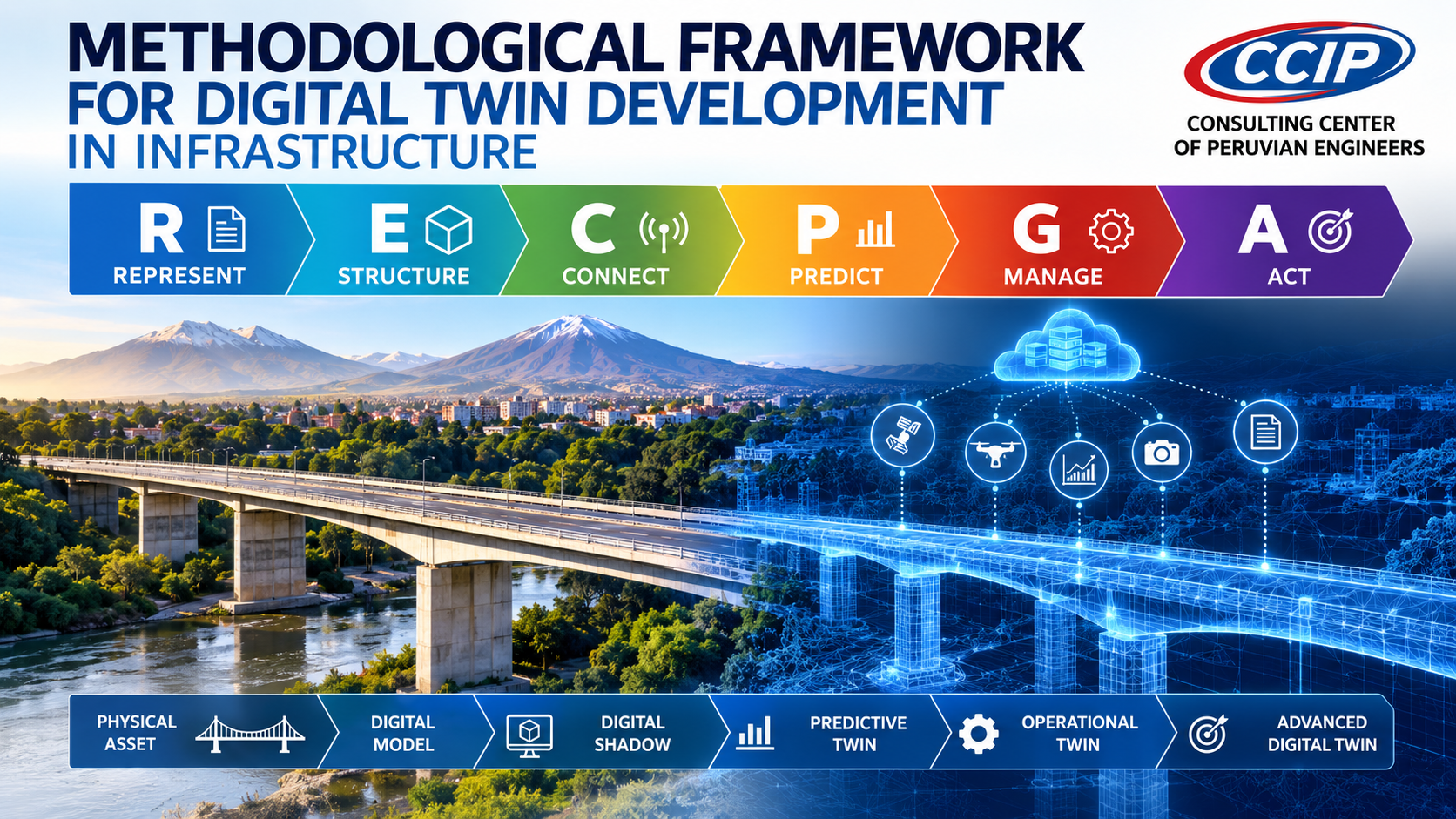
Digital Model
Structured representation of the physical asset through BIM, GIS, Reality Capture, Scan-to-BIM, technical documentation and attributes.
Six-stage maturity model: R-E-C-P-G-A
Represent · Structure · Connect · Predict · Manage · Act
A three-dimensional representation, a BIM model or a visualization platform do not, by themselves, constitute a Digital Twin. The maturity level depends on the progressive integration of the physical asset, data, models, analytics, management and interaction capabilities.
Structured representation of the physical asset through BIM, GIS, Reality Capture, Scan-to-BIM, technical documentation and attributes.
The physical asset automatically updates its digital representation through IoT, SCADA, PLC, BMS and sensor networks.
Physical → Digital
Integrates contextualization, simulation, analytics, prediction, lifecycle management and, at advanced levels, bidirectional interaction with the physical asset.
Physical ⇄ Digital
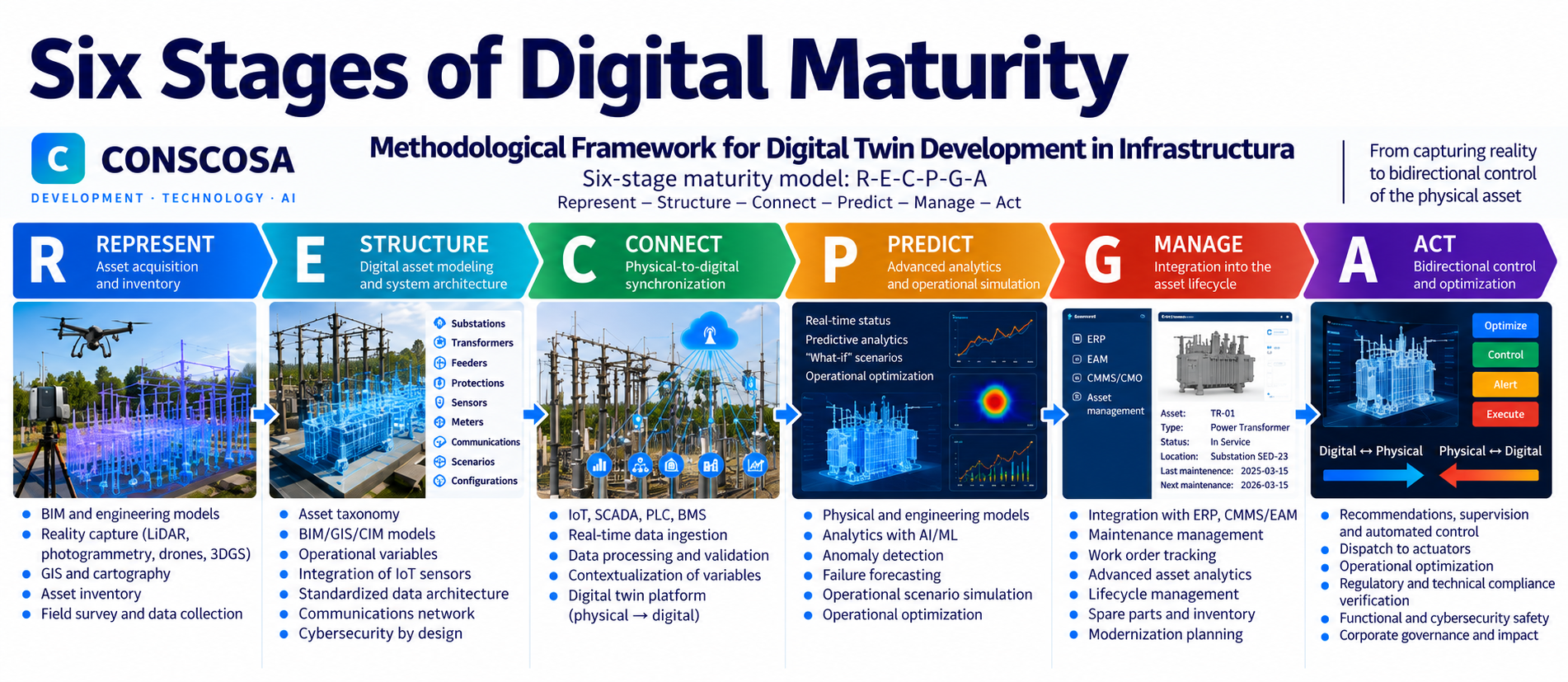
Data acquisition and asset inventory through BIM, engineering models, LiDAR, photogrammetry, drones, point clouds, 3DGS, GIS and legacy data.
Result: reliable digital representation.
Organization of assets, operational variables, sensorization, IoT, data architecture, communications and cybersecurity.
Result: structured digital model.
Integration with IoT, SCADA, PLC, BMS and supervisory systems, incorporating data ingestion, cleansing, validation and contextualization.
Result: Digital Shadow.
Physics-based and engineering models, advanced analytics, Artificial Intelligence, Machine Learning, anomaly detection and scenario simulation.
Result: Predictive Digital Twin.
Integration with ERP, CMMS/GMAO and EAM to maintain asset traceability throughout operation, maintenance, replacement and modernization.
Result: Operational Digital Twin.
Recommendation, supervision or control through bidirectional interaction, with different levels of autonomy and human oversight.
Result: Advanced Digital Twin.
The methodology does not require immediately reaching the highest level. Each stage may represent an independent level of maturity, investment and measurable outcome.
Generation, transmission, distribution, substations, BESS, microgrids and Distributed Generation.
Bridges, roads, railways, tunnels and airports.
Dams, water networks, treatment plants, pumping stations and irrigation systems.
Industrial plants, machinery, production lines and processes.
Complex buildings, hospitals, campuses, data centers and public infrastructure.
Previous sector-specific application of the Digital Twin approach to electrical distribution networks.
View Distributed Generation →Digital Twin concepts and terminology.
Architecture and information exchange for Digital Twins.
Information management using BIM.
Asset management and life cycle management.
Cybersecurity for industrial automation and control systems.
Information security management.
These references support the conceptual and technical components. The R-E-C-P-G-A maturity model constitutes the author's methodological proposal.
Luis T. Mayta Garcia – CIP 21837
Mechanical-Electrical Engineer from the National University of Engineering – 1979,
with a Master's Degree in Business Administration. Expert of the Appraisal Center
of the Peruvian College of Engineers – Lima.
Professional with experience in rural electrification project development, energy infrastructure supervision, construction management and development of new services. Specialized in projects related to renewable energy, energy-efficiency technology solutions and Digital Innovation.